Visibility Spotlight
Visibility Spotlight
October 25, 2012
The Visibility Spotlight recognizes a CPCU Society member for his or her dedication to Spreading the Word! about the value of the CPCU designation. Members are encouraged to send in their stories about how they Spread the Word! about the CPCU designation. Send an email to: cpcusocietynews@cpcusociety.org.
Visibility Spotlight: Joe B. Smith, CPCU, “Spreads the Word” with Warren Buffett
Joe B. Smith, CPCU, ARM, president and chief executive officer of SmithBrothers, recently sat down for dinner with Warren Buffett, among other guests and industry peers, to discuss business and life. From joking with Buffett about his appetite for salt to taking away a lesson on unconditional love, Smith details his dinner with the “Oracle of Omaha” below.
|
My Dinner With Warren Buffet Joe B. Smith, CPCU, ARM President and Chief Executive Officer, Smith Brothers |
|
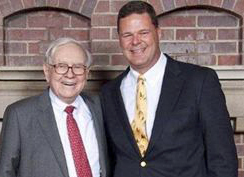
As I flew from Omaha, Neb., on the 6 a.m. flight back to Hartford, I wrote as many notes as I could, hoping not to forget any of the enlightened dinner-conversation exchanges I enjoyed the night before with the best capitalist in world, the Oracle of Omaha, Warren Buffet. That night, I texted my wife and a few friends some pictures and some updates on my night with Warren. I felt like a little kid meeting a pro baseball player―a giddy excitement I hadn’t felt in a long time.
In my 20s and 30s, I read many books related to Warren, including Securities Analysis and The Intelligent Investor, both written by Benjamin Graham, Warren’s professor and mentor at Columbia. In addition, I have read several biographies on him as well as many years of his Berkshire Hathaway annual reports and essays on these annual reports. Altogether, they have been a solid foundation not only on investing but more so on business philosophy. His ability to stay unemotional in his approach to business and stay disciplined in his actions, consistent with his philosophy, have delivered a compounded rate of return of over 20 percent throughout Berkshire’s history. He likes “boring” and is the classic contrarian. I always was amused by the confidence in his approach and his willingness to share it openly.
Although he doesn’t share stock tips, he shares his model and philosophy openly, stating that Wall Street and the general public won’t have the discipline to focus on the basics and stay away from the emotional side of investing, causing themselves losses. His value-investing approach has allowed him to take less risk with more return. His net worth at age eighty-one is more than $50 billion. He loves America and believes our best years are ahead. His conversations are refreshing, interesting, and simplistic, yet seemingly packed with wisdom. He answers questions with humorous story-telling, relating the story’s plot to the answer he provides. I asked as many questions as I could and got intriguing answers. Much of what he said tied in with what I have read or watched on CNBC, where he is often a guest.
A client of ours at Smith Brothers asked me a few years back, if I could have dinner with anyone in the world, whom would it be? My answer was John Wooden, the former UCLA basketball coach and the best teacher of teamwork and leadership who ever lived. I never got a chance to have dinner with Coach Wooden before he died. My second choice was Warren Buffet. Two years later, I found myself sitting next to Warren and having dinner with him.
I traveled to Omaha to meet with USLI, a wonderful Berkshire Hathaway company we represent at Smith Brothers for unique small business risks (such as wedding events and vacant building insurance). USLI is a profitable company run by a dynamic CEO, Tom Nerney. Tom and I played eighteen holes of golf at Omaha Country Club, where Warren is a member (although he doesn’t play anymore). Tom was hosting a business dinner to discuss USLI’s strategy and invited several agents/brokers from around the country to a meet-and-greet with Warren. Tom was gracious enough to have me sit with Warren for dinner and we, together with a few industry peers, chatted about business and life. Although sometimes I had to assist Warren in hearing some questions being asked around the table, I found him to be energetic, genuine, funny, and a guy who uses a lot of salt and likes ice cream. He got a piece of beef that was really rare and asked me for the salt, which he “poured” on his beef. Later, when he got a vanilla ice cream with hot fudge (he usually does strawberry, he told me), I jokingly passed him the salt; he got a kick out of that.
We heard stories about how deathly afraid of public speaking he was until he took a Dale Carnegie course and got the nerve to ask his then-girlfriend to marry him, which changed his life forever. We also heard about the "cold call" at the home office of GEICO, where he was let in by a janitor and GEICO’s investments director gave him an impromptu four-hour lesson on how an insurance company works that changed his career. He later purchased GEICO, and it remains one of his best investments. He often hosts groups of students in Omaha and tells them that he would invest $100,000 in each kid today for 10 percent of the student’s purchasing power for the rest of his or her life. He offers it to them right there, demonstrating how each is worth a minimum of $1 million today, if he or she undertakes to improve himself or herself and become valuable. He also stated that a student can add an automatic 50 percent return if he or she learns how to communicate. Communication skills are worth a $500,000 minimum value in his way of thinking. Almost all of the thoughts that Warren has seem to be math-related. He is superb at equating streams of potential income to value. I thought telling a group of young, anxious students that he, the best investor of all time, would invest in them today was a truly inspiring and hopeful message.
Warren feels intelligence is overrated. In fact, he jokes that if you have a 150 I.Q., then go ahead and sell 30 points. He stresses that human potential and being aware of how emotions (such as fear and greed) of groups move markets and provide opportunities for those who do not let emotions drive their decisions are what counts. He says, “Be fearful when others are greedy and greedy when others are fearful.”
Warren has seventy-four CEOs reporting directly to him. He told me they have only twenty-three people in Berkshire’s home office, and they spend their time on 17,000 pages of tax returns; Sarbanes-Oxley regulation; and the company’s annual shareholder meeting in Omaha, to which more than 40,000 people were showing up a few days after I left. Warren lets his CEOs run their own show, a clearly decentralized and autonomous approach to running a company. He told me he has learned that if you let the CEOs “do their own painting” and “applaud them a lot,” they will do just fine.
Tom Nerney is one of those seventy-four CEOs who report to Warren. When I was golfing with Tom and asked him how it was to work for and report directly to Warren Buffet, he stated Warren never asks for a meeting, a forecast, or a budget―ever. Warren is always available when Tom needs him, but Tom is never required to meet with Warren or do a budget. I couldn’t understand how a publicly traded company like Berkshire Hathaway could get away with this, so I asked Warren how this could be and what he tells Wall Street when they ask for earnings estimates. He replied that he tells the analysts he refuses to ask his seventy-four CEOs for a budget and that “they will sandbag anyway.” Of what value is reporting those sandbagged budgets to Wall Street, as they have nothing to do with the value of the companies he runs? He tells the analysts he can’t predict storms or short-term earnings, but he knows in ten years all of the companies will be just fine.
Right before I sat down for dinner, I texted a partner at Smith Brothers, Dave Soule, to ask him what one question he would like me to ask Warren. Dave is concerned about the national debt and the direction of undisciplined spending our country has fallen into. Dave wanted me to ask Warren what he thinks we should do. Warren is very bullish on America. He feels the partisan gridlock is frustrating and problematic, as we all do. He believes President Obama missed a great opportunity with Bowles-Simpson. He felt a buy-in from two powerful and influential politicians from both sides on a solution, although not perfect, was a great opportunity to move through the national debt issue. He does think, however, that we will figure this out; we will increase taxes and cut spending, and our brightest years are ahead. In his mind, no other country is close to having the model of democracy and capitalism that unleashes the power of the human race that we have in America.
One answer from Warren to a question I asked was most unexpected but the most intriguing to me. In all my following of him, I have never read or heard him say this. I asked him how he was able to drive forward through ups and downs and stay disciplined in his philosophy (which clearly has brought him success), a philosophy that does not follow the crowd.. His response on his key to success dealt with his confidence that came from his father's unconditional love. He told me his father died many years ago, and today he still feels sick when he thinks of his dad passing away. He said that the biggest investment a parent can give his or her kid is unconditional love. This was interesting because through what I’ve read about him, I understand his kids had difficulty with Warren's lack of emotions. The same lack of emotion that makes him a disciplined capitalist may make it difficult for him to communicate what he feels inside.
At dinner that night though, he was very clear that unconditional love will give a kid a lifetime of confidence and will unleash his or her potential. Unconditional love is the greatest investment, with the best return on investment, that a parent can make.
I am lucky to be able to say that my dad (and mom) gave us unconditional love, the greatest gift/investment a kid might hope for, according to the Oracle of Omaha. My dad passed away a few years ago, and I, too, feel a pit in my stomach daily because I miss him. My dad would have been the only guy I would rather have had dinner with that night in Omaha. Who would have believed that from my dinner with the best capitalist in the country, who runs and thrives on capitalism and materialism, I would take away such a reminder of unconditional love’s intangible power?
Warren was also clear that it was unconditional love you give the kids, not unconditional approval ... so your children don't get any funny ideas!